Episode 7 English: What on earth does folklore have to do with learning a foreign language?
In this episode I’d like to return to the connection between language, culture, and literature (cf. Episode 6). At the same time, want to remind you what communication is ultimately about: the exchange between people. This exchange is shaped by an aspect that is often blanked out, namely the ubiquitous culture of those people.
We need contact with others as much as we need the air we breathe. But our communication has changed drastically. As the possibilities have grown, so have our expectations. When AI optimises communication, it is a useful tool that can break down barriers and simplify processes. But it also encourages unrealistic perfectionism and can thus create barriers rather than overcoming them. We humans have been capable of unfiltered verbal communication for many millennia. Mistakes when speaking are normal – perfectionism in foreign language learning is a hindrance! (I recommend Katie Salter’s blog post on this subject: https://learnenglishwithkatie.substack.com/p/dont-panic-when-native-speakers-break-the-rules).
After all, working together to overcome fear of contact, solving misunderstandings, and sharing knowledge are naturally part of communication and have a positive effect on our relationships and our well-being. In this sense, the exchange of views on different cultures plays an important role in foreign-language contact in itself. For it is not always just about the content (“This is an Erdbeere [literally: earthberry] – in English it’s called ‘strawberry’!”), but also about the channel through which the message is conveyed and with which we explain ourselves and signal interest (“With my berry, it’s important that it grows on the ground. With your berry, is it important that it’s traditionally mulched with straw or could it be that the runners look like straws?”).
Insights into day-to-day politics and current culture require constant engagement
Of course, it’s always good to be familiar with current topics in the target language. But this kind of specialist knowledge is short-lived. Recently, for example, an acquaintance jokingly remarked during a rare chat on the street that she was probably indulging her lifestyle through this little natter. Otherwise, this acquaintance is always in a hurry, because alongside a demanding part-time job (lots of work, few pension credits) she supports her husband’s career by creating a home and doing the family work – in other words, raising the children and looking after parents in need of help among other things. All this alongside social volunteering (unpaid, of course). Her remark referred to the debate earlier this year, when Chancellor Merz (CDU) spoke out against “lifestyle part-time work”, thereby indirectly portraying part-time workers as lazy and harmful to the German economy. The word ‘lifestyle’ was on everyone’s lips for a few months. Anyone who understands an allusion like the one made by my acquaintance in a foreign language has every reason to be proud of themselves. Such understanding demonstrates a good command of the language and insight into the current political situation in the target country – and it requires constant updating. In contrast, a look at colloquial language is more rewarding.
What is often overlooked is that culture refers not only to the visible and highly esteemed art forms, such as literature, art, and classical music, but also to all the small, everyday quirks that make up the shared character of a community. There is, for example, a wealth of unspoken conventions, such as knowing whether a ‘no’ is so taboo that it is hidden within a negative ‘yes’. Or whether a ‘no’ is the answer to a difficult request that requires an inconvenient amount of effort, but is nevertheless indirectly – and with a hint of the imposition – affirmed by the ‘no’. The same word can have opposite meanings. More on that another time.
The vast collection of predominantly oral short texts, which are classified as folklore, also forms a large but often underestimated linguistic resource for culture-specific knowledge. This is why in the following I would like to break a lance for the use of folkloric text types in foreign language acquisition.
Folklore – an unspectacular but extremely rewarding subject area
The term ‘folklore’ encompasses a wide range of manifestations of the intangible cultural heritage of communities. This begins with folk dances and rituals and extends from the associated architectural and clothing traditions to a variety of oral and written text types. These include jokes, riddles, fairy tales, ghost stories, myths, proverbs, nursery rhymes, and songs.
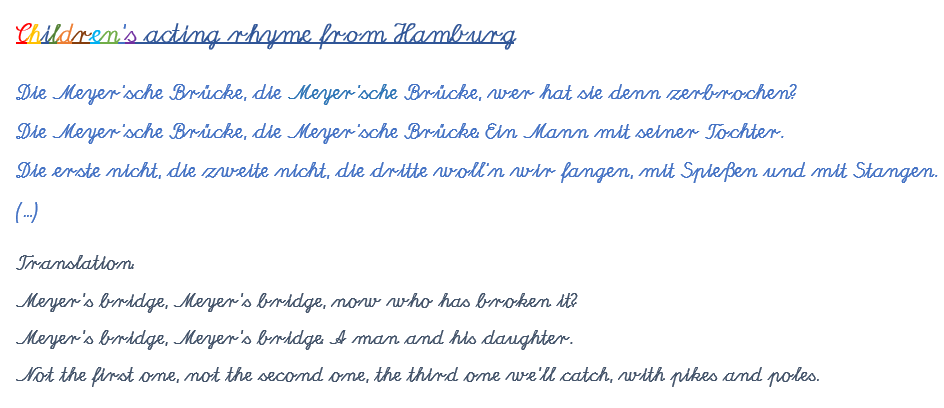
I remember this song from the 1970s. Two children form a bridge with stretched out arms, which the others have to walk through whilst singing. When the word ‘catch’ is sung, the bridge turns into a trap.
My daughter loved the game and recounted very seriously at her Berlin nursery that she had been ‘caught and beaten with pikes and poles’.
I was discreetly questioned about this: in Berlin, the song was unknown…
Folklore is a relatively stable and widespread cultural domain
Apart from the obvious and universal realm of food and drink, folklore is, in my view, the area in which language enthusiasts should invest some energy. (Of course, there are also folkloric texts relating to food; see Episode 3 on bean consumption and flatulence humour.) Folkloric texts are not only entertaining but provide easy and lasting access to important cultural spheres. They are more enduring than day-to-day politics and pop culture. Through them, one gains access not only to contemporary language but also to an entire tradition of past references to these short texts, which are often very old.
Children’s songs and fairy tales contain concentrated shared knowledge
The reach of these unassuming, short folkloric texts is far greater than it might initially appear. They are often dismissed with a smile, and research took a relatively long time to take notice of them. But the extent of their reach becomes quickly apparent once one has become aware of them: whilst works from the high literary canon—take, for example, Goethe’s Faust or Shakespeare’s Hamlet—are only taught through prolonged schooling and are relatively exclusive, the often oral texts of folklore possess a universal unifying quality. For instance, many of us were introduced to nursery rhymes and songs in nursery or primary school, at home or by other children, and had jokes, fairy tales, or ghost stories told to us; or told them to one another. These types of text therefore constitute a vast treasure trove of widely disseminated, culturally shared knowledge that surfaces in everyday speech more frequently than one might think.
Folklore then finds its way from spoken language into literature, which draws on this everyday life. Shakespeare, for instance, quotes the fairy tale of Jack and the Beanstalk in his tragedy King Lear (Act 3, Scene 4, written c. 1605) with the line “Fie, foh, and fum, I smell the blood of a British man” to evoke a terribly threat. Through the culturally widespread, unassuming texts of folklore, complex knowledge can be evoked in just a few words. At the same time, the audience gains a sense of community. This makes the transmission of such knowledge highly relevant for the integration of immigrants into their new country. Take, for example, the still-popular form of the fairy tale.

Friedrich Nietzsche (Werke in drei Bänden. München 1954, Volume 1, p. 837. Source: http://www.zeno.org/nid/2000923909X, 21.05.2026).
For example, the German fairy tale Hansel and Gretel
In German, just three words – “Knusper, knusper, knäuschen!” (a play on the verb ‘knuspern’ [to crunch]), the image of the two children Hansel and Gretel from the Grimm fairy tale can be evoked, standing by the witch’s gingerbread house and nibbling on the gingerbread from which the house is made (in older versions, the house is made of bread, the windows of sugar).
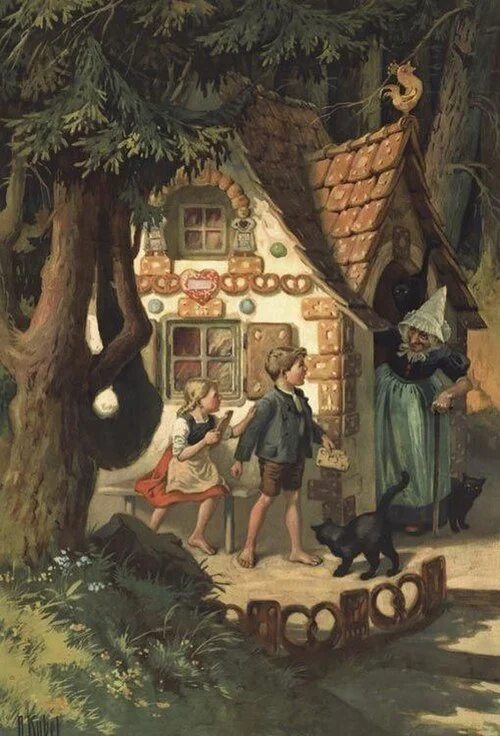
Hansel and Gretel in front of the gingerbread house (Otto Kubel, 1930. Source: https://de.wikipedia.org/wiki/H%C3%A4nsel_und_Gretel).
The wider context of the quotation then determines whether, and which further elements of the fairy tale, are to be evoked by the person quoting it.
It could, for example, be a threat of punishment (Hansel ends up behind bars and faces the threat of being baked and eaten by the witch), to which the quotation is intended to allude. But more positive interpretations are also possible; after all, the lost, hungry children are initially given tasty treats and, in the end, bring pearls and precious stones back to their poor parents’ home. In Project Gutenberg, the text can be found as Chapter 69 of the Children’s and Household Tales by the Brothers Grimm: https://projekt-gutenberg.org/authors/brueder-grimm/books/kinder-und-hausmaerchen-2/chapter/69/.
For example, the English fairy tale The Three Little Pigs
When, in English, a request or demand is answered with “Not by the hair of my chinny chin chin!”, this is initially a clear refusal. It quotes the three little pigs’ playful, three-fold ‘no’ in the fairy tale in response to the wolf’s request to be let into their house. The context of the quote then reveals whether this refusal is not taken seriously and is swept aside, just like the first two houses made of straw and wood by the wolf’s huffing and puffing. A different use of the quote could serve as a warning that the third house, made of stone, stands in the way of the request and that the enquirer, like the big bad wolf, will meet a terrible end. This only becomes clear from the context in which the quote is embedded. But the point remains: a few words convey a complex meaning!
Here is the link to Project Gutenberg, which provides the English version of the fairy tale with the charming and famous illustrations by Leonard Leslie Brooke: https://www.gutenberg.org/files/18155/18155-h/18155-h.htm.
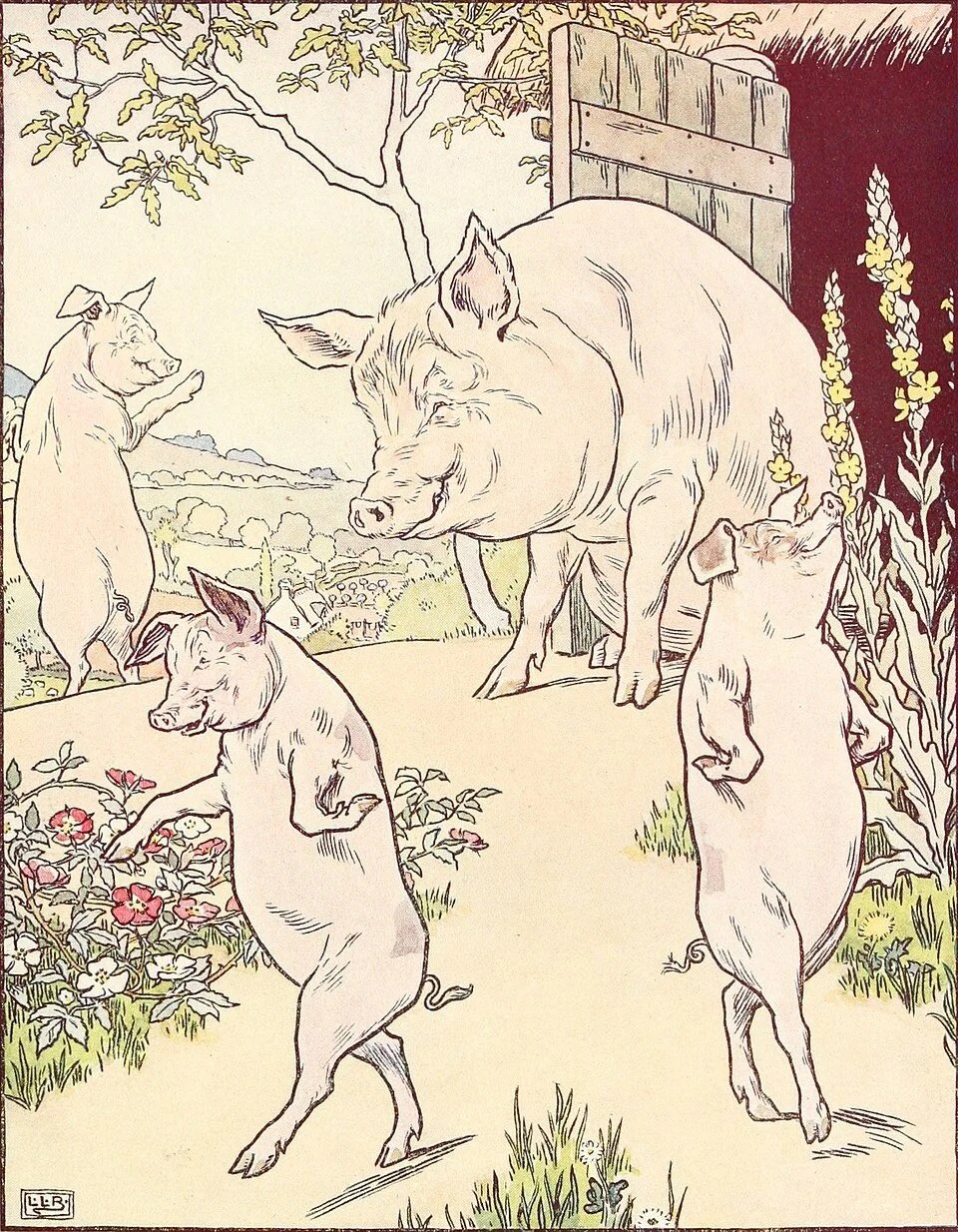
Leonard Leslie Brooke: Three Little Pigs - and mother sow, 1905. (Source: https://en.wikipedia.org/wiki/The_Three_Little_Pigs).
Incidentally, there is an award-winning advert by The Guardian (from 2012) that contains countless allusions to the fairy tale in the context of British politics at the time: https://www.youtube.com/watch?v=vDGrfhJH1P4. This illustrates the enduring presence of folklore beautifully!
Just as with learning vocabulary (including culture-specific meanings and connotations), grammar, and literature, it is therefore important for a deeper immersion in another language to get to know the customs, interests, and indeed the folklore of a language community. Which, of course, initially means investing in various learning techniques: engaging with texts (including music and film) and identifying folkloric elements, understanding vocabulary in context, researching keywords, exchanging ideas with others, ... Ideally in a group setting guided by experienced and inspiring teachers. This is where AI has its place as a tool when it comes to making tedious research tasks easier and identifying references to current affairs or literature: AI helps with searches and thus provides cognitive assistance. But when it comes to true understanding, we need to build on our own repertoire of knowledge. That is why there simply is no getting round learning vocabulary – we have to do that ourselves!
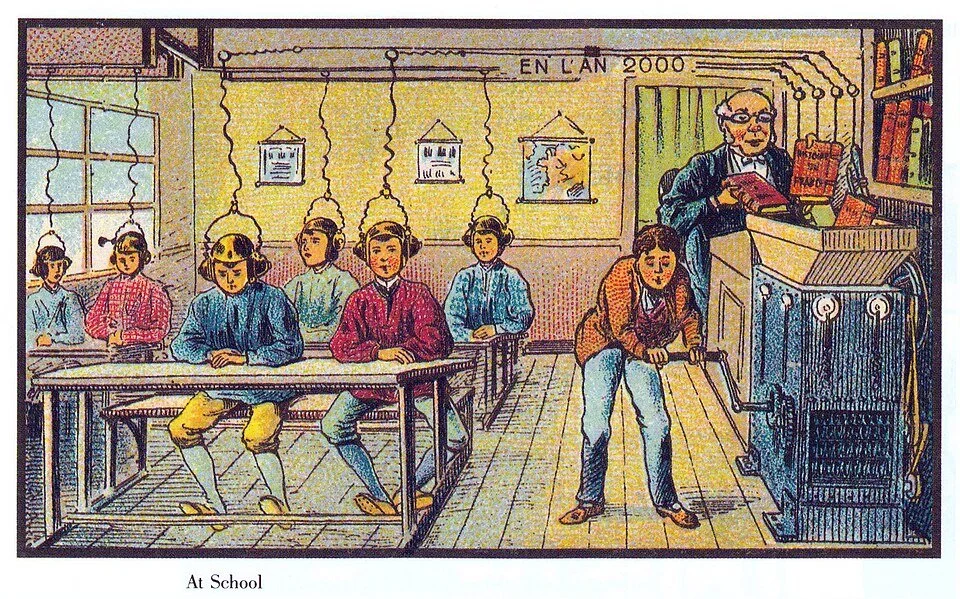
School in the year 2000 (Either Jean-Marc Côté 1901 or Villemard 1910). Source: https://en.wikipedia.org/wiki/En_L%27An_2000).
Communication across language barriers motivates, fosters community, practises, and integrates
A delightful side effect of this is interaction with other people – whether face-to-face or indirectly whilst reading and researching the selected texts. Even this can spark an inner dialogue with earlier generations. However, it becomes particularly exciting during active, live exchanges. This exchange, in turn, provides positive feedback through the enriching sharing of knowledge and discussion of interests, and rewards participants with growing motivation and a sense of community.
I like to combine my own edutainment events on British culture and literature with culinary delights and gardening activities, because eating and drinking together and pottering about in the garden is fun, and conversation flows more easily and fosters connections during practical activities (Link: https://www.swiftlinguistik.de/veranstaltungen). What matters is not how good the participants are at grammar and pronunciation, but how successfully they use the means available to them to communicate – creatively rather than strictly by the book. Mistakes then become a reason to laugh – with one another, not at one another.
For businesspeople, too, this is an important experience that eases the burden of everyday life: Being able to make oneself understood and experiencing a sense of community are the goals, not perfection of expression. We lose sight of these aspects of communication when we use AI in such a way that we experience genuine human interaction less and less, and alongside the practice, we also lose patience with others and our tolerance for frustration about our own mistakes decreases.
Incidentally, most people are happy to answer questions about their language. They enjoy sharing their knowledge of their own culture and are delighted by interest in it. After all, this is communication within their own area of expertise! (And, let’s be honest, being consulted as an expert – that simply feels good.) In such conversations, foreign language learners gain a little bit of a sense of belonging to the target culture every time – for instance, when laughing together at a culture-specific allusion or a joke, even if these perhaps had to be explained first. A lovely feeling.
If you’re curious about the phrase “Fee-fi-fo-fum!” and you’re in the area, why not arrange a literary afternoon tea with me in the garden?
Then I’ll tell you the fairy tale of Jack and the Beanstalk. Or pop by at the end of October when my former folk dance group, Rag Morris from Bristol, will be visiting Springe (https://ragmorris.com/). – If you live further afield: why not have someone tell you a joke in your target language?
And if you need the punchline explained first, no worries: You learnt something new again!
Postscript from 16 June 2026 – Pinocchio, the world-famous wooden boy with the long nose
Last week I had a lovely experience that illustrates how shared cultural knowledge makes communication more efficient. It was during a conversation about the power of ubiquitous cultural images within a culture, which make it possible to convey complex ideas in just a few words. I mentioned this blog post and was just about to take a deep breath to give a few examples. “Take the story of Pinocchio, for example,” I began.
At the mention of ‘Pinocchio’, my conversation partner immediately nodded exaggeratedly, saying in a drawn-out voice with their eyes wide open, “Yeees, yeees…”, as if I’d just spun a wild tall tale that was simply impossible to believe. At the same time, the person touched their nose and theatrically pulled it far away from their face.
With a short, simply repeated ‘Yes’, complemented by intonation, facial expressions, and gestures, a complex contextual framework was established. Pinocchio is Carlo Collodi’s endearing, yet somewhat fanciful, wooden hero from the serialised stories in the magazine Giornale per i Bambini, which were compiled into book form in 1883. Whenever he lies, his nose grows… As the novel has been translated into over 240 languages and has also been adapted for the screen several times (including a 1940 Walt Disney production), one could say that the long lying-nose has now become a universal symbol of tall tales.
This year marks the 200th anniversary of Collodi’s birth, which is why he is particularly prominent in Italy, as you can see:
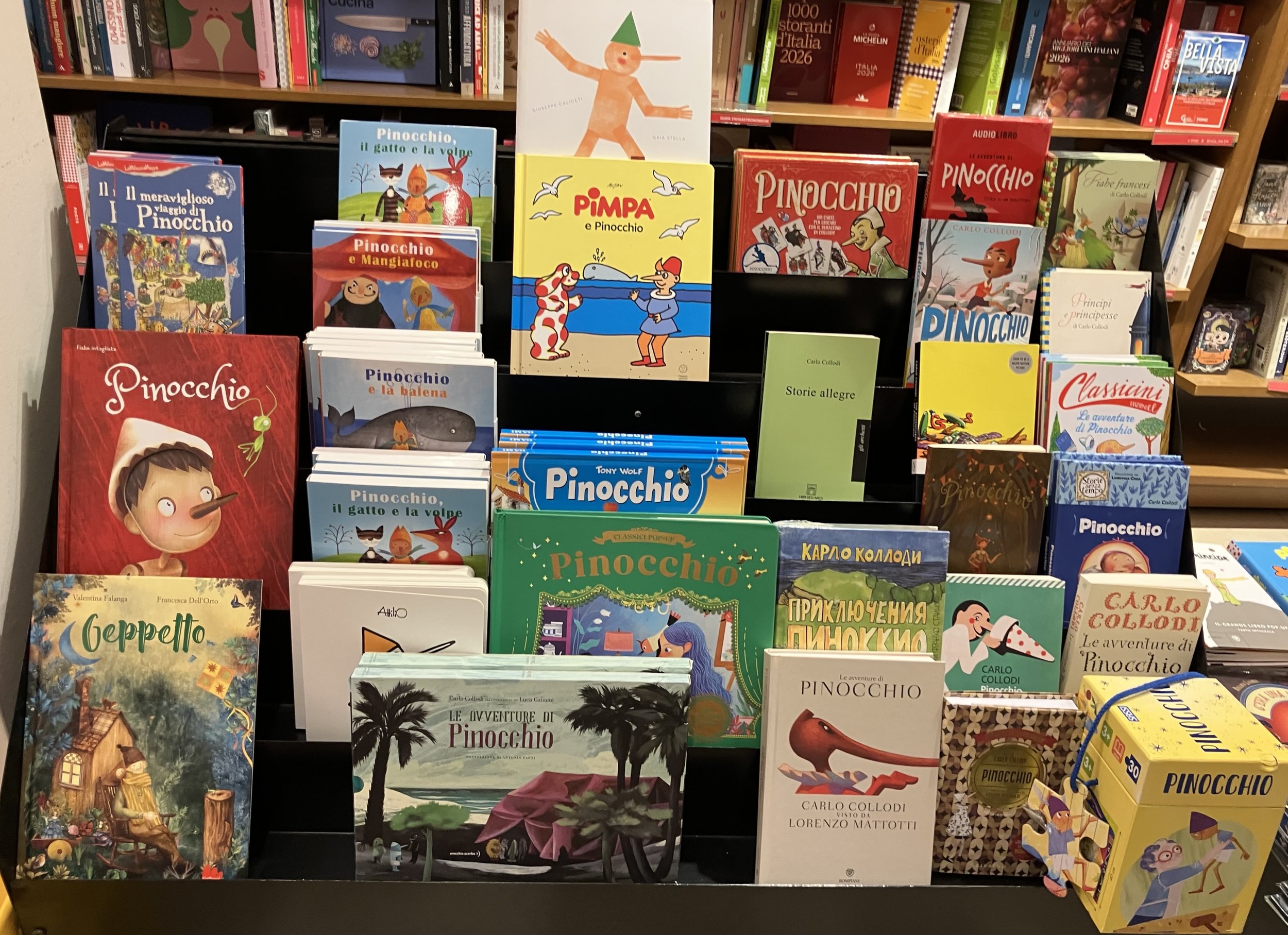
Libreria Zanichelli, Piazza Galvani, Bologna, Italy (10 June 2026). There was a huge selection of books and merchandise here, so Collodi fans: Avanti!
In this context, the German word ‘flunkern’ is noteworthy (verb and noun). Unlike the wholly reprehensible ‘Lügen’ (lying), ‘flunkern’ refers to harmless, childlike flights of fancy, and the word ‘flunkern’ in itself conveys a certain sympathy for the narration. Lying is not okay. ‘Flunkern’, however, is something that can be excused.