Transliteration of German cursive
‘Transliteration’ refers to the literal transfer of a text from one writing system to another.
I am offering the transfer of so called running scripts (Kurrentschriften), handwritten cursive blackletter, as used in the first half of the 20th century for German handwriting.
In vernacular, these scripts are sometimes referred to as ‘Sütterlin’ after a German graphic designer who designed many scripts.
Among these was a script designed in 1911 for German schools which became so famous, that his name became synonymous for handwritten German cursive script.
Note:
In order to grasp the particularities of a script it is necessary to access its details. This is particularly difficult when a text is very short: Letters that are not repeated can be hard to decipher. This poses a particular problem for proper names, in particular when it comes to names for persons or places which contain antiquated components not corresponding to modern orthography (e.g. -bohm for -baum, tree).
Exampel: Transliteration of a postcard from 1938 (private possession)
In the following postcard names are unproblematic: As customary, address and names as well as the month are written in Latin script, only the text itself is written in a German cursive.
However, the author seems to have lost concentration in line 11, writing “ihch” instead of “Ich” at the beginning of a new sentence. This little mistake does not pose a problem, as the meaning is clear from the context of the sentence. Furthermore, apart from several small “i’s” there is a capital “I” to be found in the text (see the postscript on the picture side of the postcard). This is not always the case.
Exemplary transliteration of a postcard in 1938 German cursive:
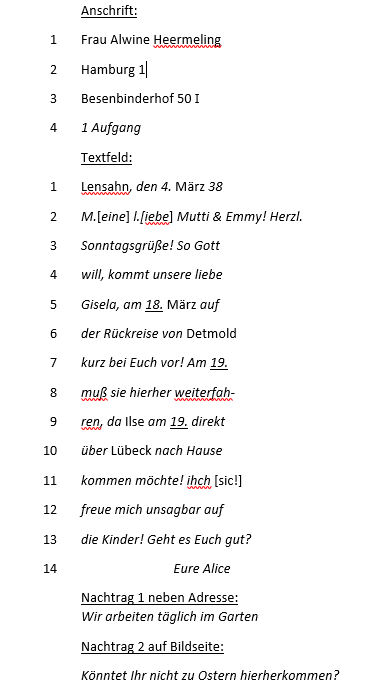
Transliteration into modern script:
address:
Mrs. Alwine Heermeling
Hamburg 1
Besenbinderhof 50 І
1st stairway
text:
Lensahn, 4th March [19]38
M.[y] d.[ear] Mum & Emmy! Warmest [abbreviated]
Sunday greetings! God
willing, will our dear
Gisela, on 18th March on
her return from Detmold
briefly stop by! On the 19th
must she travel here,
since Ilse on the 19th directly
via Lübeck home
wants to come! I [misspelling]
am looking forward inexpressibly to
the children! Are you well?
Your Alice
Postscript 1 next to address:
We are working daily in the garden
Postscript 2 on the picture side:
Couldn’t you come here for Easter?
Picture of 1938 postcard:


Pricing:
Pricing:
Because it often takes a little longer to decipher short texts (see above), I charge a basic fee of €20 [ca. 17£] for each transliterated text
plus €1,49 [ca. 1.30£] for each standard line of 53 characters.
In the example of the postcard written 1938 in German running script, my transcription into a typed, line-by-line formate would be charged as follows:
The text consisting of 394 characters (postcard text plus additions but without: address in Latin script, additional address information, and my additions in square brackets) is counted as 7.43 standard lines.
At €1.49 per line, the price would be €10.85 + basic fee of €20 = €30.85 or ca. 26,65£. An additional transfer into English (line-by-line literal translation, as given here, or a more idiomatic translation, as requested) would cost an additional 10,85€/ca. 9£ in the example.
For very short and easily legible texts, I am happy to reduce the basic fee.
For problematic texts, I reserve the right to agree on a higher price per line with you.
Please feel free to contact me for details (see below: Kontakt) or send me a decent quality photo of your text or, in the case of longer documents, a few representative extracts
as a basis for discussion.
NB: Transfer in GBP for exemplary purposes only, 16.03.2026.