Episode 6 English: Learning a language takes more than learning vocabulary and grammar
Learning to speak a language (in context) vs. studying a language at university
When I began studying Spanish and English in Hamburg thirty years ago, my master's degree was called ‘Study of Language, Culture and Literature’. All three areas were inextricably linked, despite competition between literature and linguistics. At that time, independant cultural studies programmes were still rare. Today, I increasingly notice that, despite brilliant (multi)media teaching materials, the essential connection between language, culture and literature is being lost from view. In addition, enthusiasm about the possibilities of AI is causing us to forget the complexity and context-dependence of language. Complicated things seem simple. In many contexts, this is a gain, as barriers that once seemed insurmountable are falling. But among many other things, this reduction in workload means that we practise many communication skills less and thus dull our senses to the possibilities of linguistic complexity and cultural differences. When learning to speak a language, one thing is essential: practice!
From politeness to awareness of text types – knowledge of language affects countless areas
No matter which learning method is used, there is no way around learning vocabulary. In addition, there are idioms, grammar and, ultimately, an entire linguistic universe to discover if you want to go beyond the 1:1 transfer of simple sentences. Many aspects of language cannot be intuitively grasped; on the contrary, knowledge of language often seems to contradict intuition, is complex and must be acquired through the study of scientific research methods, models and specialist vocabulary. Here is an example: as a student, I became acquainted with the concept of speakers' self-perception, which can contrast sharply with external perception. A lecture on this topic made a big impression on me. It was about interviews on certain language variants that were described as ugly or even wrong, such as variable articles (der, die or das Joghurt - the yoghurt) or certain constructions (the non-causal use of weil before a verb: weil, ich habe Hunger - because I am hungry). The interviewees stated that they themselves never used rejected variants because of their inferiority. However, the interviews proved that this was exactly what they did. This only became apparent when the conversations were listened to again. The interviewees who were confronted with this were astonished that the rejected constructions had come out of their mouths. One person even went so far as to suspect that the recordings had been falsified! This example taught me to distinguish between external and internal perception. And that we are often unaware of what we say and how we say it. I also encountered the phenomenon that our language is very important to us and criticism of it hurts us (especially when it comes to our voice).
Even if we speak a language competently, we do not automatically know how languages work. Views on linguistics as a discipline (and especially within linguistics itself) have also developed historically, so that in parallel to the linguistic content, there is a whole history of research to learn about.
And then there is the integration of linguistic research findings into general knowledge - a completely different topic. An excellent example is Helmut Henne's model of internal multilingualism in German, which is still valid today. The model is already 40 years old – and yet the baroque ideal of a uniform, fundamentally correct language still persists in many minds! (Here is a link to a study of attitudes towards and knowledge of intralingual variation among teachers in Hesse: https://www.sprachspuren.de/sprachvariation-schule/)
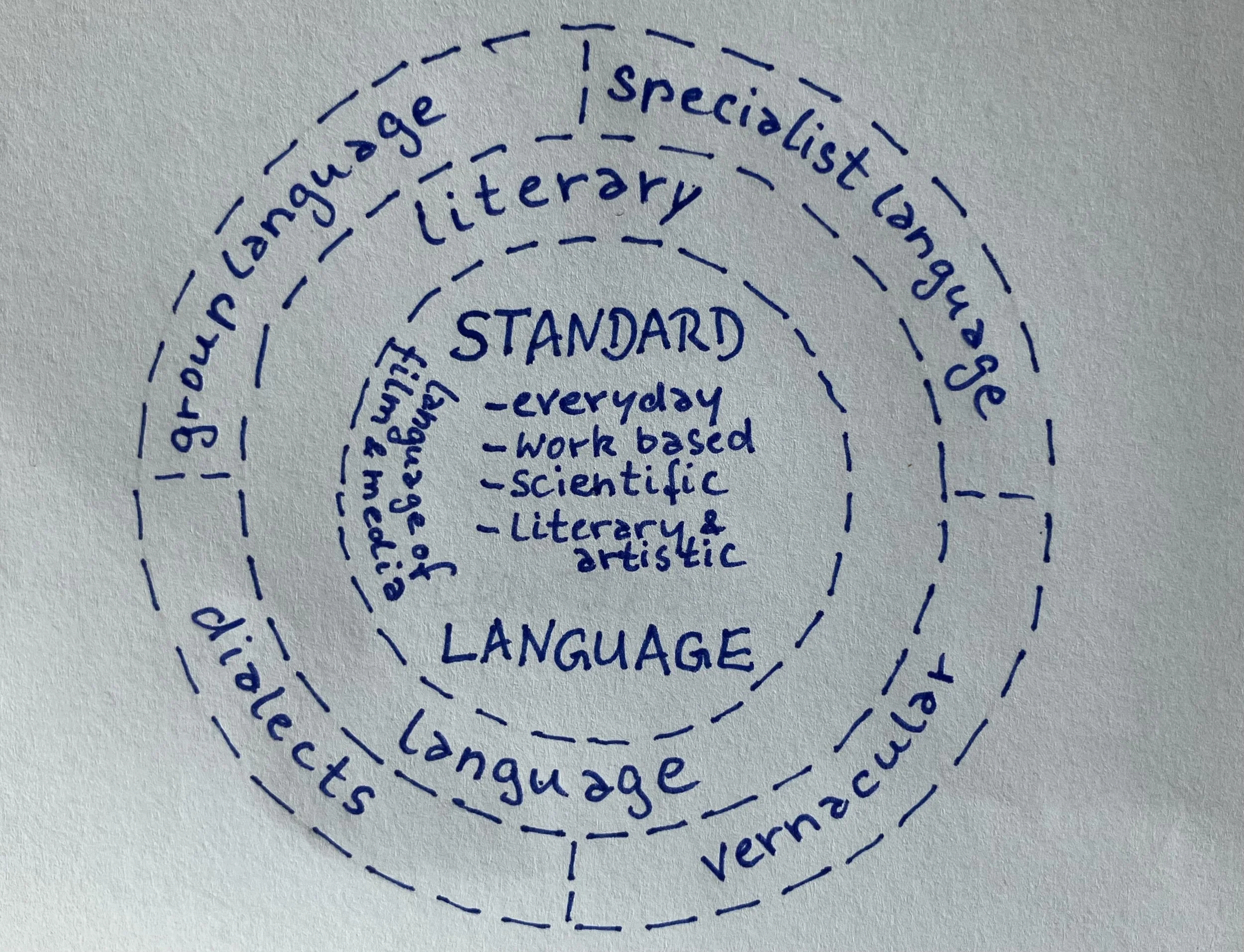
H. Henne: The Internal Multilingualism of German (translation: M. B. Lange).
From: Helmut Henne. 1986. Jugend und ihre Sprache. Darstellung, Materialien, Kritik. Berlin & New York, de Gruyter.
It was only during my studies that I realised that literature is linked to different languages and cultures, but also to subcultures and population groups, and is therefore incredibly diverse. It was Helmut Henne who taught me that every person masters many different language variants, depending on the occasion and the audience. But even as a child, I realised that learning a language is much more than just memorising words and sentence structures. Hence my fascination with the diverse cultural aspects of language.
Cultural knowledge is part of language competence
To this day, I try to gather information about local customs, rules of politeness and especially taboos before travelling. ... after all, there are many things you only notice once you know about them. And despite my lifelong interest, I continue to encounter concepts that amaze me because they are so foreign to me. Before a stay in Singapore, I was surprised to learn that younger people there politely avoid direct eye contact with older people, which is perceived as aggressive. In our culture, this is easily misinterpreted as inattentive, disrespectful or even insincere. And did you know that in Australia and Oceania, photos of deceased persons are taboo in some cultures? While we like to remember our deceased loved ones with the help of photographs, this can be seen as disrespectful by indigenous people. I became aware of this through a warning on an Australian magazine: ‘Caution, this magazine contains images of deceased persons!’
A completely different type of language knowledge is the knowledge of how to deal with different types of text and linguistic registers. Here, it is important to decide what belongs in a particular text and which language variant is appropriate in which situation. As native speakers, we acquire this almost unconsciously from our family and then at school. However, this dimension is often missing when learning a foreign language. However, expectations of text types can vary culturally! This is why Germans abroad have a reputation for giving lectures that are impossible to listen to. They write highly complex texts for international meetings and conferences and translate them 1:1 into English. Such presentations are dreaded because they often overwhelm not only other foreign participants, but even native English speakers. This is partly due to the complicated written language, which is not at all suitable for presentations. But also because of the overall structure of the text. This is based on different attitudes towards the use of examples in English (it is important to arouse interest, facts can be provided later – there is a leap of faith) and in German (scientific rigour must be proven to begin with – perseverance may be required, entertainment is frivolous). Knowledge of such differences hardly ever features in foreign language acquisition. As a consequence, when using translation programmes, users lack sensitivity to cultural shifts and misunderstandings remain undetected...
Many people believe that languages can be translated 1:1
Despite my knowledge of attitudes towards language, I was recently astonished when an acquaintance commented in passing on my work as a language consultant for English and German, saying that her children (both successful in highly qualified professions) ‘could speak English' themselves and therefore naturally did not need a coach. A surprising statement from someone who was highly qualified herself, or isn't feedback indispensable, especially for professionals?
Do both of these children really have a perfect ear for languages, effortlessly and instantly absorb language rules, devour literature and its theory (people who don't need sleep), and at the same time are highly sensitive to cultural differences? People who find the perfect words in every context, even in a foreign language? Probably not. Rather, this was an example of the parental Dunning-Kruger effect, i.e. the overestimation of one's own offspring's abilities. I struggled to refrain from commenting that even in their own language, specialists who are poor communicators are often stereotyped, and that this phenomenon is only exacerbated by poor linguistic transfer (with lack of cultural knowledge) into other languages. When searching the internet for an entertaining example, I found this text from my school days. It is the literal translation of a very idiomatic conversation of two Germans abroad.

“Two men heavy on wire.” - “Zwei Männer schwer auf Draht.” Text from the 1980s (anonymous), located on the following site: http://www.schaefersbernd.de/stranger.html (09.03.2026).
Linguistics is largely unknown as a discipline
The conversation mentioned above showed me once again that we in linguistics simply communicate far too little about our work. Like many other sciences, we are PR grouches and, as a relatively young discipline, do not enjoy the prestige bonus that traditional disciplines can claim. Yet advertising in particular benefits from our research! But we don't apply our knowledge to ourselves...
Linguistics examines diverse aspects of language such as speech organs, sound, variability of articulation, language structures, the aforementioned text types and registers, the relationship between what is said and what is understood, language acquisition, multilingualism, and so on and so forth. It often works in close collaboration with other disciplines, such as history, psychology, medicine, philosophy, computer science, media studies and, not to forget, our ancestor, theology.
Linguistic research thus makes important contributions – not least to our understanding of the world. But these contributions often remain invisible, and linguistic knowledge is considered trivial. As a result, many people assume they know everything about language simply because they can speak. It may be a silly question, but would you perform heart surgery because you have a heart yourself?
Communication in a foreign language benefits from cultural context knowledge
Learning many words and expressions does not mean that you can move smoothly in a language area and avoid cultural faux pas. For example, what comes to your mind when a British person invites you to ‘come for tea’? What time do you think of? And what kind of invitation is it? Exactly, it depends on the circles you move in and the region you are in – it could be an invitation to afternoon tea with biscuits or to a proper dinner.
And did you know that ‘you'll have had your tea’ is an old-fashioned, formal but rather brusque way of saying that no food will be provided during the current communicative event (i.e. ‘don't expect anything to eat’)? And who has ever visited American friends unannounced, only to be embarrassed to learn that ‘come visit!’ does not mean you should just drop by spontaneously? Without an explanation of the context, we cannot manage some cultural transfers on our own.
Almost forty years ago, the father of a Chinese friend offered me a glass of red wine. He had seen on television that wine is part of Western culture and had bought a bottle of French dry red wine. He was amazed by the cork alone and almost injured himself when he pushed it into the bottle with a screwdriver. The wine spurted out and caused a huge mess. He didn't like the taste of the sour drink either, so he simply put the wine, complete with bits of cork floating in it, in a kitchen cupboard. When I got to enjoy it months later, it had already turned to vinegar and I was terribly embarrased. I felt uneasy being confronted with the cultural ignorance on display, because I myself was completely out of my depth and overwhelmed by the absence of cutlery I was familiar with and the presence of house gods surrounded by incense sticks. Have you had a similar experience? Feel free to write to me about your own experiences with cultural misunderstandings!
As I said, we only see what we know. In my coaching, it is therefore always important to me to explain cultural idiosyncrasies and to foster understanding for the differences associated with them. If you want to get beyond a certain point in language acquisition, you have to familiarise yourself with the target culture. Behind what is superficially strange, there is often a lot of interesting information to be found, not least about your own culture. Of course, there are countless areas and associated linguistic varieties, so it makes sense to limit yourself to the areas that affect you professionally or interest you privately. After all, how many people know the technical vocabulary for building a church organ or precision electronics in their native language?
With so much complexity, mistakes are inevitable, and learners need a certain amount of resilience. I recently met a colleague who advises making mistakes in the foreign language on purpose on a regular basis. Just for practice and to train awareness (it's true, the earth won't shake, and sometimes a mistake can spark interesting conversations). In seminars on language norms, I have repeatedly given my students the exercise of sending an email or letter with spelling mistakes. Try it! Really. You're allowed to: after all, norms only apply to public correspondence – in private, you can write however you want! The Spanish author Juan Ramón Jiménez (1881–1958), for example, used his own personal spelling – and still won the Nobel Prize for Literature.
In addition to this, it is important to listen to your linguistic intuition, which grows with increasing knowledge, and dare to simply ask when in doubt. Just as you would do in German. Because just by looking at something, you can't tell how it tastes or feels, or what tradition it comes from. And because even for native English speakers, it's not always clear whether ‘why don't you come for tea’ is an invitation to a hearty dinner or an afternoon cup of tea with some biscuits. It all depends on the context.

Just a cup of tea and a (big!) biscuit …
Finally: A swift quiz on German culture & language
If you feel like taking a short test on your cultural and linguistic knowledge of German or if you would like to use this test in class, please check out this link. You can also find a quiz about British English in the German version of this post.
I have tried hard to find realistic examples and at the same time offer something to puzzle over!
Please let me know how you fare via E-Mail or LinkedIn.
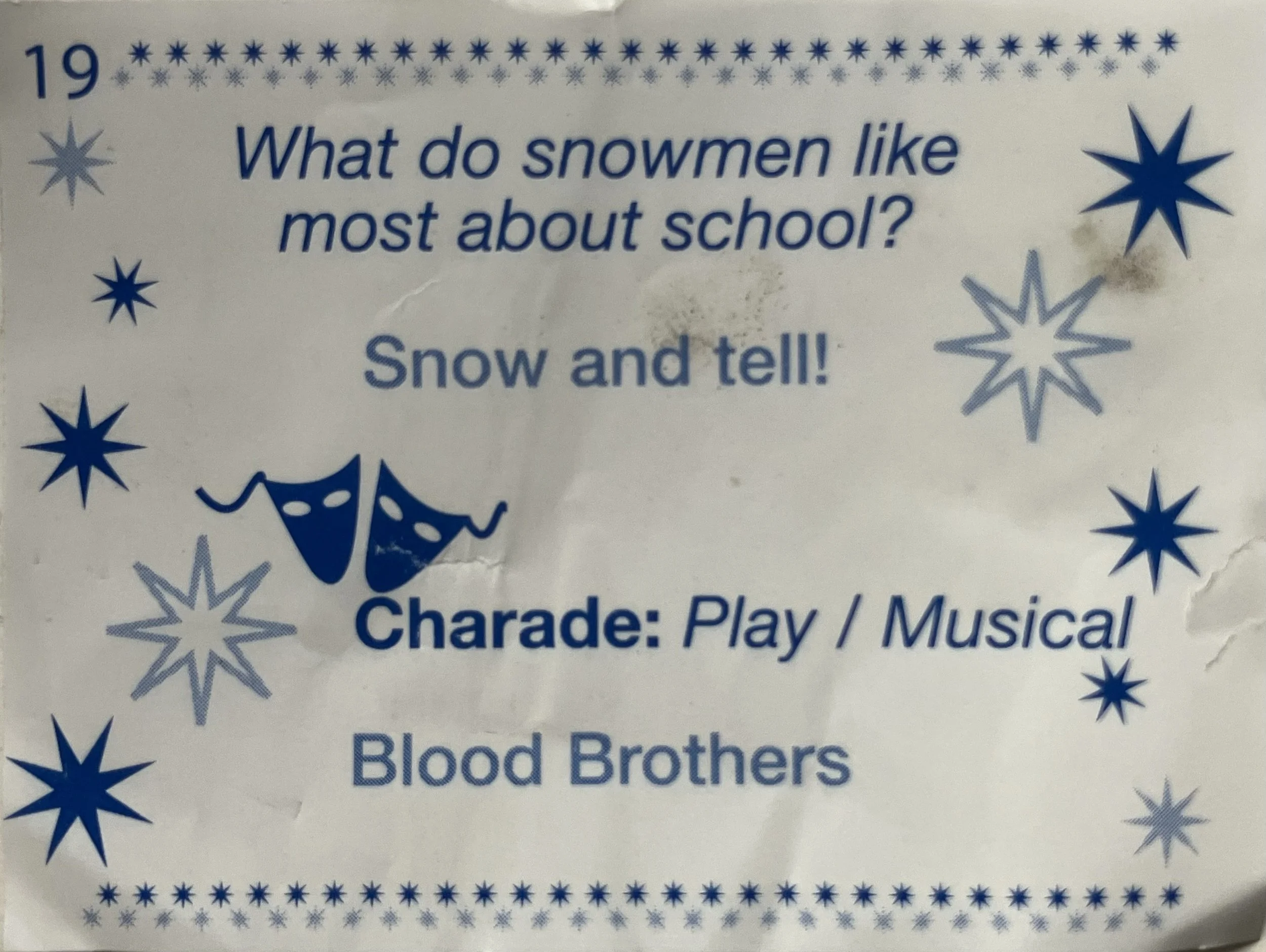
Jokes and wordplays can be very hard to get for learners of a foreign language.
This is from a Christmas cracker. The pun refers to ‘show and tell’. Children are allowed to bring something to school and talk about it.
Parents sweat blood and water when it comes to fragile, irreplaceable, difficult-to-transport items!